
Titin force in muscle cells alters lattice order, thick and thin filament protein connections
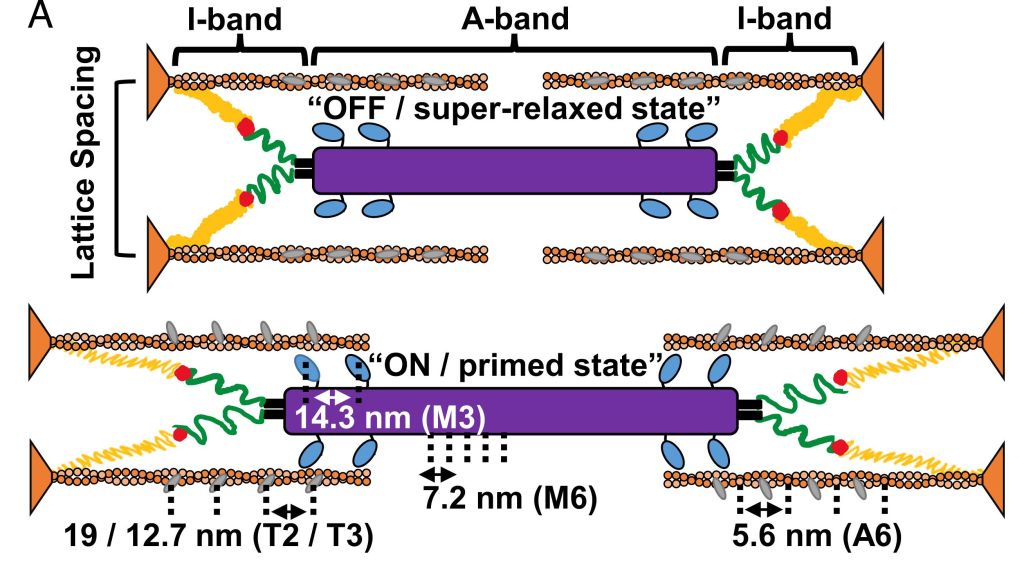
Muscles can produce more force when stretched to a longer length at the same level of activating calcium, a poorly understood phenomenon known as myofilament length dependent activation (LDA). It was suggested several years ago that passive force generated by the giant elastic protein titin could be the length sensor behind this phenomenon, but direct evidence has been lacking. Investigators from the University of Muenster in Germany, Northern Arizona University, University of British Columbia, and the Illinois Institute of Technology used a mouse model with a cleavage site inserted into the titin protein allowing titin to be enzymatically cut in the mature tissue (with TEVp protease) to make it ineffective. Small-angle X-ray diffraction of muscle from these mice with and without cleavage showed that titin cleavage diminished the changes in length-dependent structural signatures (“priming”) associated with LDA. Strikingly, a titin-sensitive, length-dependent structural changes were also seen in thin filaments, which seems only possible if there are bridging structures between the thick and thin filaments in resting muscle, potentially comprised of myosin-binding protein C. These experiments firmly established titin as the length sensor in LDA and showed that LDA involves structural changes in both thick and thin filaments.
See: Anthony L Hessel1 , Weikang Ma2 , Nicole Mazara3 , Paige E Rice4 , Devin Nissen2, Henry Gong2, Michel Kuehn1 , Thomas Irving2 , Wolfgang A Linke1 . Titin force in muscle cells alters lattice order, thick and thin filament protein formation. Proc Natl Acad Sci U S A. Nov 29;119(48):e2209441119 (2022). DOI: 10.1073/pnas.2209441119. PMCID: PMC9860331.
Affiliations:
1Institute of Physiology II, University of Muenster, Muenster, 48149 Germany.
2 BioCAT, Department of Biology, Illinois Institute of Technology, Chicago, IL 60616.
3 School of Kinesiology, University of British Columbia, Vancouver, Canada V6T 1Z1.
4 Department of Biological Sciences, Northern Arizona University, Flagstaff AZ 86011.
 MuscleX Lab